Who We Are
The Leone XIV International Study Centre ETS is a research, educational and cultural institution established within the Order of Saint Augustine and dedicated to the figure and teaching of Pope Leo XIV.
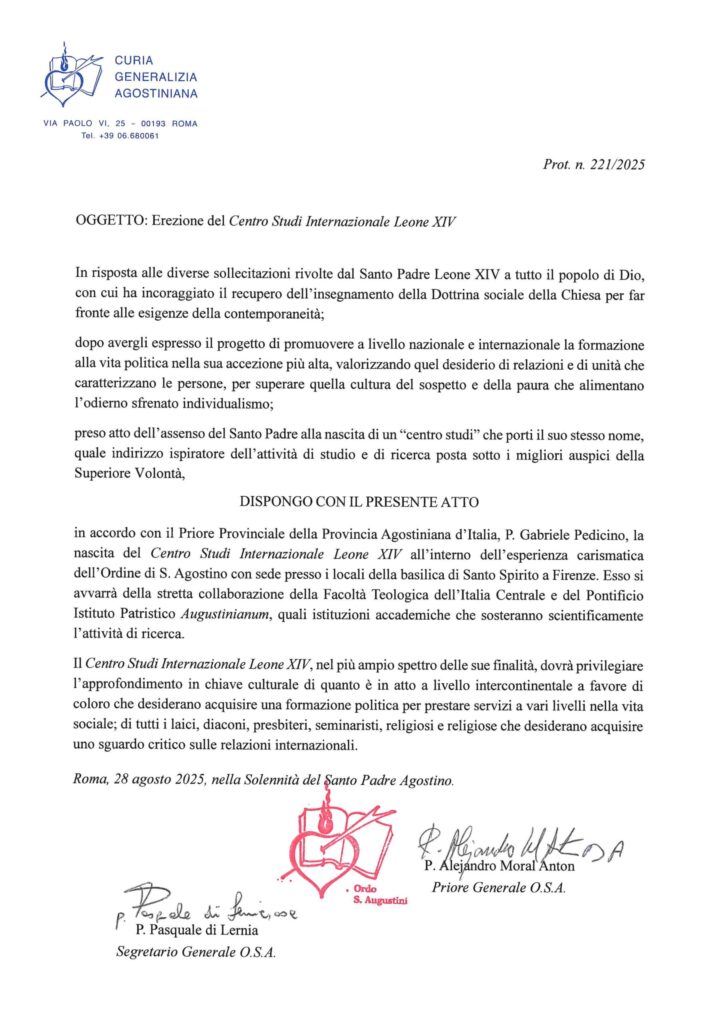
Established in August 2025 with the assent of the Holy Father through a decree issued by the then Prior General of the Order of Saint Augustine, Fr Alejandro Moral Antón, in agreement with the Provincial Prior of the Augustinian Province of Italy, Fr Gabriele Pedicino, the Study Centre was subsequently incorporated as a Third Sector Organisation (ETS) through a notarial deed in December 2025.
The Centre is based at the Augustinian Convent of Santo Spirito in Florence, a place that preserves its spiritual and cultural roots and serves as a meeting point between the Augustinian tradition, academic research, and commitment to public and social life.
Origins and Inspiration
The Study Centre was born in response to the invitation of Pope Leo XIV to rediscover the value of the Social Doctrine of the Church as an essential instrument for understanding the transformations of the contemporary world and fostering a responsible presence in public life.
The Centre draws its inspiration from the tradition of Saint Augustine, placing at its core the human person, the communal dimension of life, and the pursuit of the common good. In this perspective, the Study Centre seeks to be a place of encounter among cultures, disciplines, and perspectives, promoting dialogue and cooperation between academia, institutions, and civil society.
Our Mission
The Leone XIV International Study Centre ETS pursues civic, educational, and social purposes through research, education, and cultural outreach activities.
Its mission is to promote, in Italy and internationally, a formation for public and political life understood as service to the common good, responsibility towards the community, and the building of relationships founded on solidarity, justice, and peace.
In pursuing these objectives, the Centre operates in a non-partisan and non-political manner, respecting pluralism of ideas, academic freedom, and dialogue among different cultural, scientific, and religious perspectives.
What We Do
The Study Centre develops research, educational, and cultural initiatives aimed at students, scholars, public administrators, social workers, religious men and women, and all those interested in understanding the major issues of our time.
It promotes educational programmes in political, economic, and international studies, carries out socially relevant research projects, organises conferences, seminars, workshops, and public events, and encourages dialogue between academic reflection and institutional practice.
Through publications, digital resources, and outreach initiatives, the Centre contributes to the dissemination of scientific and cultural content inspired by the principles of the Social Doctrine of the Church and open to interdisciplinary and international dialogue.
Audience and Partners
The Centre’s activities are addressed to lay people, religious men and women, seminarians, deacons, priests, public officials, professionals, students, and scholars interested in public life, international relations, and integral human development.
The Centre collaborates with universities, academic institutions, public bodies, civil society organisations, ecclesial communities, and associative networks, promoting cooperation and dialogue at both national and international levels.
Scientific and Academic Cooperation
In pursuing its mission, the Study Centre relies primarily on the collaboration of the Theological Faculty of Central Italy and the Pontifical Patristic Institute Augustinianum, both explicitly mentioned in the decree establishing the Centre.
Through agreements, partnerships, and joint projects, the Centre also develops cooperative relationships with universities, research centres, and educational institutions in Italy and abroad, contributing to the creation of an international network dedicated to the study of the Social Doctrine of the Church, public life, and global relations.
Governance
The Leone XIV International Study Centre ETS adopts a governance model based on transparency, participation, and responsibility.
Its organisational structure includes governing bodies, scientific advisory bodies, committees, and working groups that contribute to the development of the Centre’s institutional, educational, and cultural activities in accordance with its Statute.